As an Amazon Associate, we earn from qualifying purchases. Some links on this site are affiliate links at no extra cost to you. Our recommendations are based on thorough research and editorial judgment.


Baking Books: Ratios, Temperature, and Process Notes

Baking enthusiasts will treasure books like “BakeWise” by Shirley O. Corriher (hardcover, 512 pages) for its recipes and scientific insights! Another gem, “How Baking Works” by Paula Figoni, provides clear explorations and quizzes to reinforce concepts. Additionally, “On Food and Cooking” by Harold McGee enriches understanding of food science. These resources emphasize essential ratios, temperature control, and process notes critical for baking success, making your kitchen adventures consistent and delicious—stay tuned for more tips to elevate your baking!
Key Takeaways
- Baking relies on precise ingredient ratios like 1 part sugar, 2 parts fat, and 3 parts flour for optimal consistency and results.
- Ideal baking temperatures range from 325°F to 375°F, crucial for achieving proper texture and color through the Maillard reaction.
- Using a kitchen scale for precise measurements minimizes variability, ensuring successful outcomes in baked goods.
- Visual cues, like achieving a golden-brown hue, are more reliable than strict baking times for determining doneness.
- Recommended baking science books enrich understanding of baking principles, including ratios and temperature control for successful recipes.
The Importance of Ratios in Baking
You may be interested



Baking, in its essence, thrives on the precise harmony of ratios, which not only serve as a guiding principle for recipes but also enhance a baker’s creative freedom! Ratios in baking provide a foundational framework essential for producing various successful recipes, whether it’s a simple dough or a complex pastry. For instance, a classic cookie dough typically follows the ratio of 1 part sugar, 2 parts fat, and 3 parts flour, ensuring consistency in taste and texture when adjusting batch sizes. Michael Ruhlman’s enlightening book “Ratio” (Wiley Publishing, 2009) reveals this science of baking through clear explanations and approachable ratios across categories. In baking, accurate measurements matter tremendously; even small deviations can drastically influence outcomes, making attention to detail a baker’s best ally! Additionally, visual support is crucial in cookbooks, as it enhances the understanding of complex baking techniques and helps bakers visualize the desired end results.
Recommended Products


FASTER FAN, BETTER RESULTS: The newly designed and engineered fan and housing can produce 100% faster fan speed for quicker cooking and irresistibly crispier and golden-brown results
Understanding Temperature Control

Understanding the intricacies of temperature control can transform a kitchen experience from merely following recipes to mastering the art of baking! Accurate temperature management is vital, as it shapes the science of cooking and impacts everything from rise to texture. Ideal baking recipes typically fall between 325°F (163°C) and 375°F (191°C), while the Maillard reaction begins promoting nice browning above 285°F (140°C). To achieve perfect results, preheating the oven for 15-20 minutes guarantees even heat distribution. Additionally, ingredient temperatures matter—room temperature butter and eggs (around 68°F or 20°C) enhance emulsification! For high-altitude bakers, adjusting both temperature and bake times is critical, keeping in mind lower atmospheric pressure can alter cooking dynamics. It’s all about those delicious outcomes! High-quality baking can benefit from premium acid-free stock for recipe notes, preserving them over time while ensuring they remain readable and intact.
Recommended Products

Powerful 96,000 BTU Gas Grill Performance This gas grill features 6 high-efficiency stainless steel burners, a rear infrared grill burner, and a side burner delivering up to 96,000 BTUs, making it ideal for outdoor cooking, BBQ grilling, and high-heat searing.
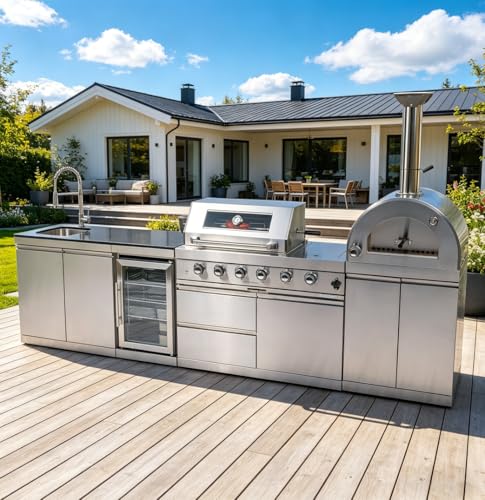
🔥 108000 BTU Multi-Function Outdoor Kitchen Island This Outdoor Kitchen Island combines a high-performance Gas Grill, Pizza Oven, Rotisserie, and Smoker Grill into one complete Barbecue Grill Station. Designed for outdoor cooking enthusiasts who want a full BBQ Island experience at home.

【108000 BTU TOTAL COOKING POWER】Features 4 tubular stainless steel high efficiency burners with rear ceramic infrared burner for 72000 BTU output, paired with a 35000 BTU pizza ovenEquipped with 485 sq.in grill cooking area and a 20.5 x 18.8 inch pizza oven space, including 8mm stainless steel cooking grids and stainless steel warming rack
Key Process Notes for Successful Baking

Mastering the nuances of baking requires attention to several key processes, ensuring that every cake, cookie, and pastry turns out just right! Utilizing a kitchen scale for precise measurements minimizes variability in baking recipes, leading to consistent, delightful results. Understanding ingredient interactions, particularly how gluten develops through water and kneading, allows bakers to manipulate cookie dough for the perfect texture. Accurate temperature control is equally essential; improper temperatures can dramatically affect rise and color. Additionally, monitoring bake times through visual cues—like a cookie’s golden-brown hue or the clean toothpick test for cakes—proves more reliable than strict timetables. Embracing these essential processes fuels creativity and success in the kitchen, elevating every baking experience! For those exploring different diets, it’s crucial to consider specialty ingredients that might be required for certain recipes to ensure accessibility and inclusivity in your baking endeavors.
Recommended Baking Science Books
For any passionate baker keen to deepen their knowledge of the craft, a well-chosen book on baking science serves as an invaluable ally! Among the recommended baking science books, “How Baking Works” by Paula Figoni (Wiley, 2008) provides a detailed exploration of the science behind baking with quizzes and lab exercises. Michael Ruhlman’s “Ratio” (Scribner, 2009) focuses on the essential basic ratios that govern recipe development, ensuring successful outcomes. “BakeWise” by Shirley O. Corriher (Scribner, 2008) is a treasure trove of over 200 recipes and scientific insights that demystify the baking process. And don’t miss Harold McGee’s classic “On Food and Cooking” (Scribner, 2004), which dives deep into food science, enriching any baker’s understanding! Additionally, books like *Bread Science: The Chemistry and Craft of Making Bread* by Emily Buehler explore the chemistry of baking and provide solutions to common issues, making them ideal for bakers who want to enhance their skills through science.
Recommended Products

![The Baking Answer Book Solutions to Every Problem Youll Ever Face; Answers to Every Question Youll Ever Ask by Chattman, Lauren [Storey Publishing, LLC,2009] (Paperback)](https://m.media-amazon.com/images/I/51noezPlhFL._SL500_.jpg)
Exploring Ingredient Interactions
Ingredient interactions in baking are a fascinating area of exploration that can greatly affect the outcome of a dish. By understanding how ingredients behave together, bakers predict flavor and texture changes, enhancing their culinary creations. For instance, chemical reactions between acids and baking soda can lead to lighter goods, while the 1:2:3 ratio of sugar, fat, and flour influences cookie dough consistency. Baking science books provide insights into these interactions, with detailed master recipes showcasing how to manipulate key components for delightful results. Cooking with both butter and vegetable oil not only retains moisture but also enriches flavor! (It’s practically alchemy—minus the lab coats!) The right balance of ratios and ingredients reveals a world of possibility for both novice and seasoned bakers. Additionally, having user-friendly instructions and substitution options can simplify the process and ensure successful baking outcomes, especially for those with dietary restrictions.
Troubleshooting Common Baking Issues
While baking can be a delightful adventure, it often comes with its fair share of hiccups, making troubleshooting essential for success! Many issues arise from understanding ingredient ratios; for instance, maintaining a cookie dough ratio of 1 part sugar to 2 parts fat and 3 parts flour is crucial. Incorrect oven temperatures can lead to disappointing outcomes, such as cakes sinking or breads refusing to rise, so an oven thermometer is invaluable! Additionally, overmixing can create dense textures, so mix batters until just combined! Humidity and altitude influence baking results, sometimes requiring adjustments in flour amounts or specific recipes. Rotating pans midway during baking promotes even browning—a small tweak for impressive results! Happy baking!
For those interested in woodworking, chip carving books offer comprehensive resources tailored for novices to enhance their skills in wood selection, tool use, and essential techniques.
Recommended Products

100 PRESETS - The Bravo features 12 preset cooking functions including air frying, grilling, baking, broiling, roasting, dehydrating, reheating, defrosting, toasting, and more. Additionally, it comes with 100 pre-programmed recipe presets and 30 memory slots for your convenience.

6-in-1 Versatility: The Traeger Pro 22 is the original wood pellet smoker and grill combo trusted by. Grill, smoke, bake, roast, braise, and BBQ. Enjoy authentic wood-fired flavor in every meal using this pellet grill built for all your outdoor cooking needs.

112 PRESETS- Bravo convection oven is programmed with 12 preset cooking functions for air frying, grilling, baking, broiling, roasting, dehydrating, reheating, defrosting, toasting & more. It also has additional 100 pre-programmed recipe presets
How to Adjust Recipes With Ratios
Baking enthusiasts constantly seek ways to enhance their creations, and understanding how to adjust recipes with ratios can open up a world of culinary possibilities! The best baking science books teach essential fundamental ratios—like 1 part sugar, 2 parts fat, and 3 parts flour for cookies—allowing bakers to easily adjust recipes without sacrificing flavor or texture. Maintaining proper ratios guarantees delicious results, whether they’re reducing sugar for a less sweet cake or substituting fats for health reasons. Utilizing a kitchen scale to measure by weight rather than volume can greatly improve accuracy, making it simpler to scale recipes. Armed with knowledge of common baking ratios, bakers can confidently tweak recipes, resulting in delightful variations while preserving important chemical reactions! Incorporating visual aids from pastry cookbooks like “Pastry for Beginners” can further enhance a baker’s ability to master the intricacies of recipe adjustment.
Recommended Products

REDUCE BAD CHOLESTEROL – The American Heart Association recommends that one way to reduce the saturated fats in meats is to use a rack to drain off the fat when cooking. That is precisely how Pro Plus 2 cooks. A 60-day trial has shown that 75% of participants effectively decreased their cholesterol levels when doing nothing but cooking with the Nuwave Oven.

MAKE ADJUSTMENTS ON-THE-FLY – Want hotter temperature or need to cook it longer? No problem. Simply adjust on-the-fly any time. Starting the cooking process over is not necessary. Bravo toaster oven's intuitive digital controls are easy to operate. Control not only the time and temperature but also customize the top and bottom heaters.

HIGH SPEED FAN - Achieve irresistibly crisp, golden-brown results with the new 2024 fan and housing design delivering 100% faster speeds, cooking food quicker.
The Role of Technique in Baking
Technique serves as the backbone of successful baking, transforming simple ingredients into extraordinary masterpieces that delight the senses! Mastering essential baking techniques directly impacts flavor, texture, and appearance, with mixing methods like creaming butter and sugar or folding meticulously being critical for creating perfect cakes and custards. Additionally, understanding ingredient interactions enhances the process; for example, knowing how flour reacts with liquids can elevate doughs and batters. Precise temperature control is crucial, particularly in yeast activation and candy making, where an oven thermometer is your best friend! Finally, utilizing foundational baking ratios equips bakers to confidently experiment, leading to innovative variations of cherished recipes. Detailed instructions and photographs in baking books can greatly assist beginners in visualizing techniques and understanding each step of the process. Embrace technique, and the possibilities are endless—happy baking excitement awaits!
Enhancing Creativity in the Kitchen
Creativity thrives in the kitchen when bakers embrace the adventure of ingredient experimentation, revealing delightful surprises with each new recipe created! By understanding essential baking ratios, such as those in Michael Ruhlman’s “Ratio,” bakers can skillfully substitute ingredients without losing balance, inspiring exciting creations. Pairing flavors, as explored in “The Flavor Bible,” encourages delightful combinations that may seem unconventional but yield remarkable results! Mastery of fundamental techniques, like dough-making, empowers bakers to personalize recipes with what’s available in their pantry. Furthermore, engaging with educational baking books fosters understanding of baking’s principles, building confidence. The ideal book size for portability and convenience can be beneficial for those who enjoy baking on the move, similar to how coloring books are designed for easy travel. A well-stocked pantry invites spontaneous sessions, allowing creativity to flourish, enveloping bakers in a deliciously innovative world. Let the baking adventures begin!
Frequently Asked Questions
What Types of Flour Are Best for Different Baking Recipes?
In a world of flour, all-purpose flour reigns supreme, while bread flour brings unparalleled strength. Cake flour whispers delicately, whole wheat boasts hearty charm, and pastry flour dances lightly, leaving gluten-free options looking for creative expression.
How Can I Measure Ingredients Accurately Without a Scale?
To measure ingredients accurately without a scale, one can use measuring cups for volume measurements, apply leveling techniques for precision, and utilize the spooning method. Proper baking tools facilitate effective ingredient conversion, ensuring consistent results.
Can I Substitute Ingredients Without Changing Ratios?
Ingredient substitutions often require ratio adjustments to maintain desirable baking outcomes. Altering ingredients can affect flavor profiles and lead to texture changes. Experimenting with different combinations can yield interesting results, but careful consideration is necessary for success.
What Is the Best Way to Store Baked Goods?
Storing baked goods in airtight containers greatly extends freshness—up to 200% longer. Room temperature storage works for a few days, while freezing preserves ingredient longevity. Moisture retention tips include covering with plastic wrap or using specific packaging methods.
How Do Altitude and Humidity Affect Baking Outcomes?
Altitude adjustments often require increased baking temperatures and longer rise times, while varying humidity levels affect ingredient reactions and moisture content. Both factors greatly influence flavor development and overall baking outcomes, necessitating careful consideration for successful results.